
What a new advertising channel reveals about the foundations underneath it.
Over the past few days, I haven’t been studying ChatGPT Ads. I’ve been setting them up. Tracking, landing pages, crawlers, conversions. And somewhere between two tests, one thing became very clear.
Picture this. Someone asks ChatGPT how to strengthen their brand. Your ad appears underneath the answer. They click.
And then?
They simply land on your website. The same place your Google visitors and LinkedIn contacts end up. The channel is new. The destination isn’t.
You can buy the space under the answer.
Not the answer itself.
An ad buys visibility and, with a bit of luck, a click. What happens next is not something you can buy. Whether someone understands what you do. Whether your page builds trust. Whether that visitor actually takes action.
Reach amplifies what’s already there. A clear story becomes stronger. A vague story just gets louder.
After the click
When ChatGPT Ads start appearing, the first thought is often: should we be doing something with this too?
Fair question. A new channel feels like a new opportunity.
But the deeper I got into setting it up, the more another question kept coming back. Does what’s already there still fit who we are today?
That’s not criticism. That’s what growth does. Many companies have moved further than their communication has. The offer has shifted, expertise has grown, customers have changed. But the website sometimes still tells an earlier version of the story.
And today, there’s more than a human visitor reading along. Search engines and AI systems are also trying to understand who you are and whether they can trust the information they find.
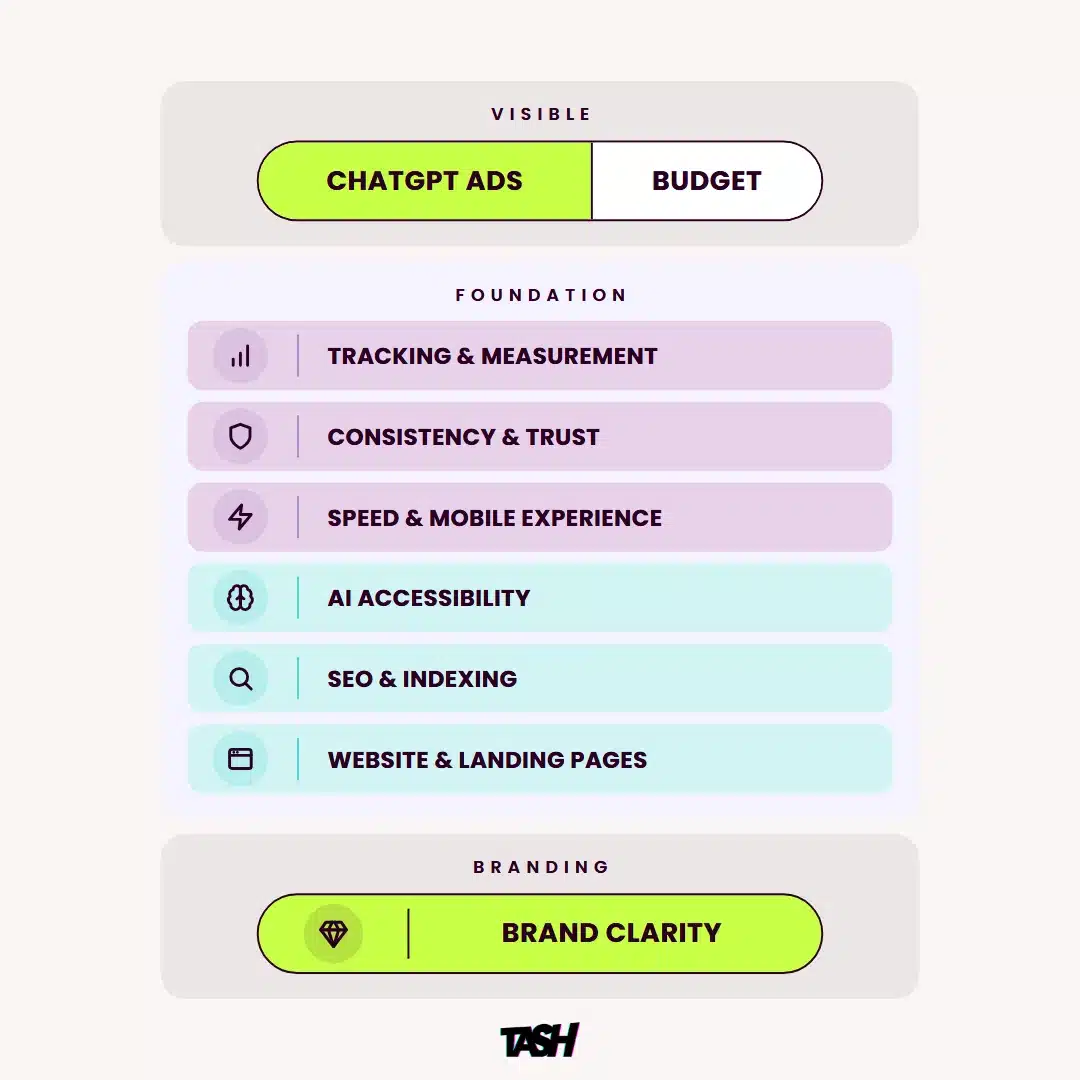
So beneath that one ad, there are layers.
Who you are
The bottom layer is brand clarity.
Not your logo. What you stand for, who you’re for and what you actually offer today.
Can someone who doesn’t know you quickly understand why you’re relevant? An AI system is effectively asking the same question. It compares what you say about yourself with what it can find elsewhere. If that picture is vague or contradictory, it can’t communicate anything particularly clear about you either.
If you don’t explain yourself clearly, you leave the explanation to others. Or to machines.
Where people land
Your website rests on that foundation.
A click only has value if the place behind it works. Is the page logically structured? Is there proof that you can do what you promise? Does a visitor know what to do next? And does the experience still fit the company you’ve become?
Speed matters too. Not because you need a perfect score, but because the experience matters. If people have to wait, they’re more likely to leave. Especially on mobile.
Getting found
People no longer search only through Google. They ask questions. In ChatGPT, Gemini and other AI systems.
That doesn’t make SEO irrelevant.
SEO isn’t disappearing.
Search is getting broader.
The fundamentals largely remain the same. Your pages need to be findable. Your information needs to be clear. And crawlers, the programs search engines and AI systems use to read websites, shouldn’t be blocked by accident. A strict firewall or security setting can sometimes do that without anyone noticing.
No trick, then. Just a website that people, search engines and AI systems can find, read and understand.
The lever
Only now does advertising fully enter the picture. And this is where it gets interesting.
I’m not against ads. Quite the opposite. A good campaign creates reach, brings in new people and creates movement where things were standing still. ChatGPT Ads add something of their own: you appear inside a conversation where someone is already actively thinking about a question.
But an accelerator does what the word says. It accelerates. You still need to bring the direction and the foundation yourself.
A campaign on a clear foundation becomes leverage. On a shaky foundation, it’s mainly an expensive way to discover the cracks.
Keeping it aligned
And then it’s never completely finished. Your company changes. Platforms change. Search changes.
That doesn’t mean constant rebuilding. It means maintenance, alignment and someone who keeps sight of the whole. AI can accelerate, structure and analyse. What feels relevant, credible and genuinely yours remains a human choice.
At TASH, that’s why we don’t see brand, online presence, campaigns and creative continuity as separate projects. Each has its own role. But the strength of the whole depends on how well they work together.
Check it yourself
5 things you can check yourself
You don’t need to be an AI expert for this. These five checks already tell you a lot.
1. Can someone understand what you do in 10 seconds?
Show your homepage to someone who doesn’t know your company well. Can they tell what you do, who it’s for and why it’s relevant?
2. Can Google find your most important pages?
Check Google Search Console to see whether your homepage, main services and key offer pages are indexed. Indexed simply means Google has found the page and included it.
3. Can AI systems technically read your website?
Ask your web developer: “Are we accidentally blocking OpenAI crawlers or other relevant systems through robots.txt, a firewall, CAPTCHA or another security layer?” You don’t need to investigate the technical details yourself. The question is whether someone has checked this intentionally.
4. Does your website work smoothly on mobile?
Test an important page in PageSpeed Insights. Not to chase 100/100, but to see whether people have to wait, whether the page jumps around and whether everything works properly on a smartphone.
5. Are you telling the same story everywhere?
Put your website, LinkedIn, Google Business Profile, social channels and profile copy side by side. Do they reinforce each other? Or do they describe three different versions of the same company?
Want to see how TASH approaches a strong digital foundation?
View Online PresenceThe first question
We’re continuing to test ChatGPT Ads. I genuinely find them interesting.
But working with them has made one thing very visible: how much sits underneath a single ad.
More reach is valuable. Reach that leads to something solid is far more powerful.
So perhaps the first question isn’t: should we advertise in ChatGPT?
But: if someone finds us today, does our story match what they find?